
Bahir Dar, one of the best growing town of Ethiopia famous for flame trees lining the streets and located on the shore of the biggest lake of Ethiopia, Lake Tana.
Lake Tana is the source of the Blue Nile, and the most dramatic wonder here is the Blue Nile Falls; in flood-stage it is more than 1300 feet wide. After dropping over a sheer chasm more than 150 feet deep, the mist drenches viewers a half mile away. In a gorge created by the waterfall is a small rain forest lush with tropical vegetation and inhabited by lively monkeys and a multitude of spectacular birds. Now a days more than 90% of the waterfall is used for hydro electric power. January is the best time of the year to see the falls. But to go there and walking in the river gorge and the surrounding scenery is god experience. After visiting the waterfall at 35 km from Bahir Dar.
After lunch board a boat for a cruise on Lake Tana to visit two of the island’s monasteries. Located on the forested Zege Peninsula, Ura Kidhane Mihret is the most impressive of the southern monasteries. The walls of the church are completely covered with remarkable 16th-century murals that offer a revealing look into medieval Ethiopia. Nearby is Azuwa Maryam, containing several fascinating paintings. Back to Bahir Dar, Summerland Hotel.
After breakfast we start the drive to Gondar. The road is crossing many types of highland and lowland agricultural fields. On your way you see farmers and people from the rural villages walking to the nearby towns to/from small town markets. In Northern Ethiopia Saturday is market day and Sunday rest day. We will have several stops for pictures. Arrive Gondar after around 3 hours drive and check in to Taye Hotel.
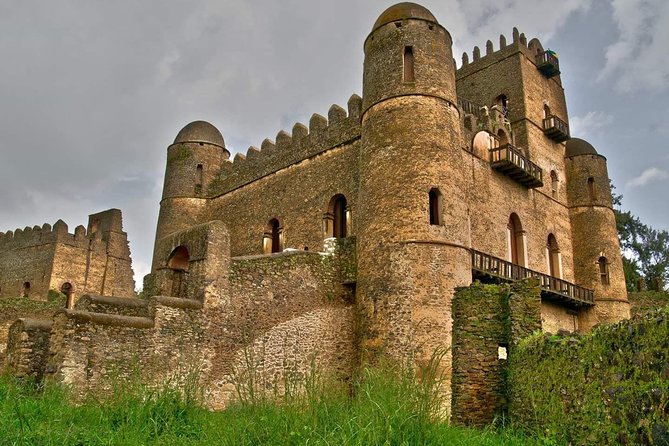
After lunch we start the visit of the sites. Gondar is where magnificent fortified palaces dominate the landscape. The oldest and most impressive is the two-story palace of Emperor Fasilidas, built of solid basalt stones. Other royal buildings include the library of Emperor Yohannes I, the House of Song where royal ceremonies took place, the elegant reception and banquet hall of Emperor Bakaffa, and the palace of this king's wife. Just outside of town is the Bathing Palace where Epiphany is celebrated each year. Also visit the Church of Debre Birhan Selassie, an imposing structure with its harmony of brightly colored ceilings completely covered with intricately painted angels.
We visit Woleka, Falashas (Ethiopian Jews) village is Just 3km north of Gonder, several craft stalls with ‘Stars of David’ and ‘’ signs signal what’s really the former Falasha village of Wolleka. Once the home to a thriving population of Falashas, most were taken to Israel in the 1980s and today none remain. There are, however, a few original houses with interesting artwork on their fronts.
The 100 km drive take you to the Debark town, the gate of the Semein Mountain National Park. Afetr peaking scout and local guide we drive another 20 km to the park. Semein is one of the sites registered by UNESCO as world heritage site. We drive and walk at different sites for scenery wild life. Semein is a home of the red listed Ethiopian Wolf and Walia Ibex. and Chilada baboons. After the visit of the park over night in semein Lodge, a lodge on the hieghest altitude in Africa.
After early breakfast we start the drive to Gondar with in the senic mountains crossed by the road. We will have several stops like the view of kossoye mountain view.
Before we reach Gondar we stop to visit the village called Woleka. We visit Woleka, Falashas (Ethiopian Jews) village is Just 3km north of Gonder, several craft stalls with ‘Stars of David’ and ‘’ signs signal what’s really the former Falasha village of Wolleka. Once the home to a thriving population of Falashas, most were taken to Israel in the 1980s and today none remain. There are, however, a few original houses with interesting artwork on their fronts.
After the adoption of Christianity as the state religion, Falashas had their land confiscated for refusing to convert. To survive, many became skilled craftspeople. Research suggests Falashas may have provided the labour for the construction and decoration of Gonder’s castles.
Another interesting place to see at the nearby is Project Ploughshare Women’s Crafts Training Center which is helping disadvantaged women rekindle this craft, along with traditional Amhara weaving and basketry. You can watch the women working Monday to Saturday and buy the high-quality pottery every day.
This ancient city, with its half-buried ruins of palaces, monolithic stelae, and subterranean tombs, is one of Ethiopia's most historic sites. Reputedly the capital of the Queen of Sheba, today Axum is the hub of Ethiopian Christianity. Visit the Park of the Obelisks where several colossal monoliths still stand together, marking the tombs of the Axumite royals. Nearby, is the subterranean Tomb of Ramha, a former king of Axum. Beneath the Palace of Kaleb, steep stone steps lead to underground galleries and chambers, locally believed to be the treasury of Emperor Kaleb.
Visit a historically important dedicatory stone dating to about 320 AD with an inscription written in three languages - Sabaean, Ge'ez (earliest written Ethiopian language), and Greek, and explore the tomb of King Basen, who ruled at the time of the birth of Christ. Also explore Gobadura, where Axum’s giant stelae were quarried, and see the impressive relief drawing of a lion cut into a large boulder. Axum is where the Ark of the Covenant of Biblical fame is reported to be hidden within the compound of the Church of Saint Mary of Zion. We will see the new, and rather garish church built with the support of Haile Selassie, and the small outbuilding nearby that purportedly houses the renowned Ark.
Today we drive out of Axum to the eastern direction. Our first stop would be on the mountains of Adwa which is about 35 km from Axum. The landscape look like “ Mountains came for conference and never go back. “ In addition to the amazing landscape, here Ethiopians made history of unforgettable in these mountains.
March 1, 1896, military clash at Adwa, in north-central Ethiopia, between the Ethiopian army of King Menilek II and Italian forces. The decisive Ethiopian victory checked Italy’s attempt to build an empire in Africa.
On February 28 the Italian government sent a furious telegram to try to goad him into action. Desperate to retrieve his position, General Baratieri advanced to Adwa with about 20,000 professional fighters against an Ethiopian army of some 80,000 non professional and voluntary men. The Italian columns, moreover, were disorganized and lacked adequate maps of the area. Humiliatingly routed on March 1 by Menilek’s forces, the Italians retreated through difficult terrain, harassed by a hostile population. As much as 70 percent of the Italian force was killed, wounded, or captured. The battle of Adwa was a stunning victory for Ethiopia but a rout and a disaster for Italy. Adwa – the story of Africans seeing to their own freedom – played out against a background of almost unrelenting European expansion into Africa. The success of Ethiopia’s forces assured that Ethiopia would be the only African country successfully to resist European colonization before 1914.
After the visit of the battle field we continue to Yeha.The oldest standing structure in Ethiopia is located in Yeha: the temple of Yeha. This is a tower built in the Sabaean style, and dated through comparison with ancient structures in South Arabia to around 700 BC. Although no radiocarbon dating testing has been performed on samples from site, this date for the Great Tower is supported by local inscriptions. Yeha is also the location of an Ethiopian Orthodox monastery, founded according to tradition by Abba Aftse, one of the Nine Saints. In his account of Ethiopia, Francisco Álvares mentions visiting this town in 1520 (which he called "Abbafaçem"), and provides a description of the ancient tower, the monastery, and the local church.[4] This church was either the rededicated Great Temple, or a now destroyed building which the Deutsche Aksum-Expedition described in the early 20th century.
Eight hundred years ago King Lalibela created a marvelous gift to the world. Often called the Eighth Wonder of the World, Lalibela contains towering churches that were carved from the soft, volcanic tuff in which they stand. Some lie almost completely hidden in deep trenches, and others stand in open quarried caves. A complex and bewildering labyrinth of tunnels and narrow passageways with crypts, grottoes, and galleries connects them all. Within this mystical world, priests go about their daily tasks, seemingly oblivious of the outside world. Standing 38 feet tall with seventy-two pillars, Medhane Alem is not only the largest in Lalibela, it is the largest monolithic rock-hewn church in the world. The oldest of the churches, dedicated to the Virgin Mary, Bet Maryam is the only Lalibela monolith with a porch. The remains of exquisite early frescoes can be seen on the ceiling and upper walls, and there are many elaborately carved details on the piers, capitals, and arches.
The area of Lalibela is full wonders of landscapes. Today we drive out of lalibela to the area called Ganate Maryam for one more rock-hewn church and amazing landscape.
to Addis Ababa, lunch, visit the national museum or ethnological museum of Addis Ababa University depending your arrival time in Addis.
National Museum : The museum is presenting selected artifacts worthy of exhibition using the best display techniques available as a means of education and enjoyment for the general public. Exhibits of the national museum are displayed under different sections. Paleontology and pre- history; - Lucy and other fossils including stone tools, Historical and Archaeological findings that depict the early history from the pre-Axumite times to the 16th century AD, Ethnography: - Traditional and ceremonial costumes, jewellery… etc. reflecting the diversified cultures of the various ethnic groups, Modern Art: - Selected paintings and sculptures from different Ethiopian artists, such as; Maitre Artist Laureate Afework Tekle. Almost every object has captions so that visitors can learn about the Nation’s rich history.
Ethnological Museum of Addis Ababa University : This contemporary museum truly displays superb artifacts and handicrafts from Ethiopia’s peoples. Instead of following the typical static and geographical layout that most museums fall into, these displays are based upon the life cycle. First comes Childhood, with birth, games, rites of passage and traditional tales. We particularly enjoyed the ‘Yem Tale’, a story of selfishness, dead leopards and sore tails! Adulthood probes into beliefs, nomadism, traditional medicine, war, pilgrimages, hunting, body culture and handicrafts. The last topic is Death and Beyond, with burial structures, stelae and tombs. The exhibition gives a great insight into Ethiopia’s many rich cultures.
Other rooms show the preserved bedroom, bathroom and exorbitant changing room of Emperor Haile Selassie,
The 2nd floor shows the vibrant hall focuses on religious art, with an exceptional series of diptychs, triptychs, icons, crosses and magic scrolls. The collection of icons is the largest and most representative in the world. Senses of another sort are traditional music gently fills the air and the black surrounds leave you nothing to look at besides the instruments – brilliant.
Afternoon shopping and then dinner in traditional restaurant with traditional song and dense