
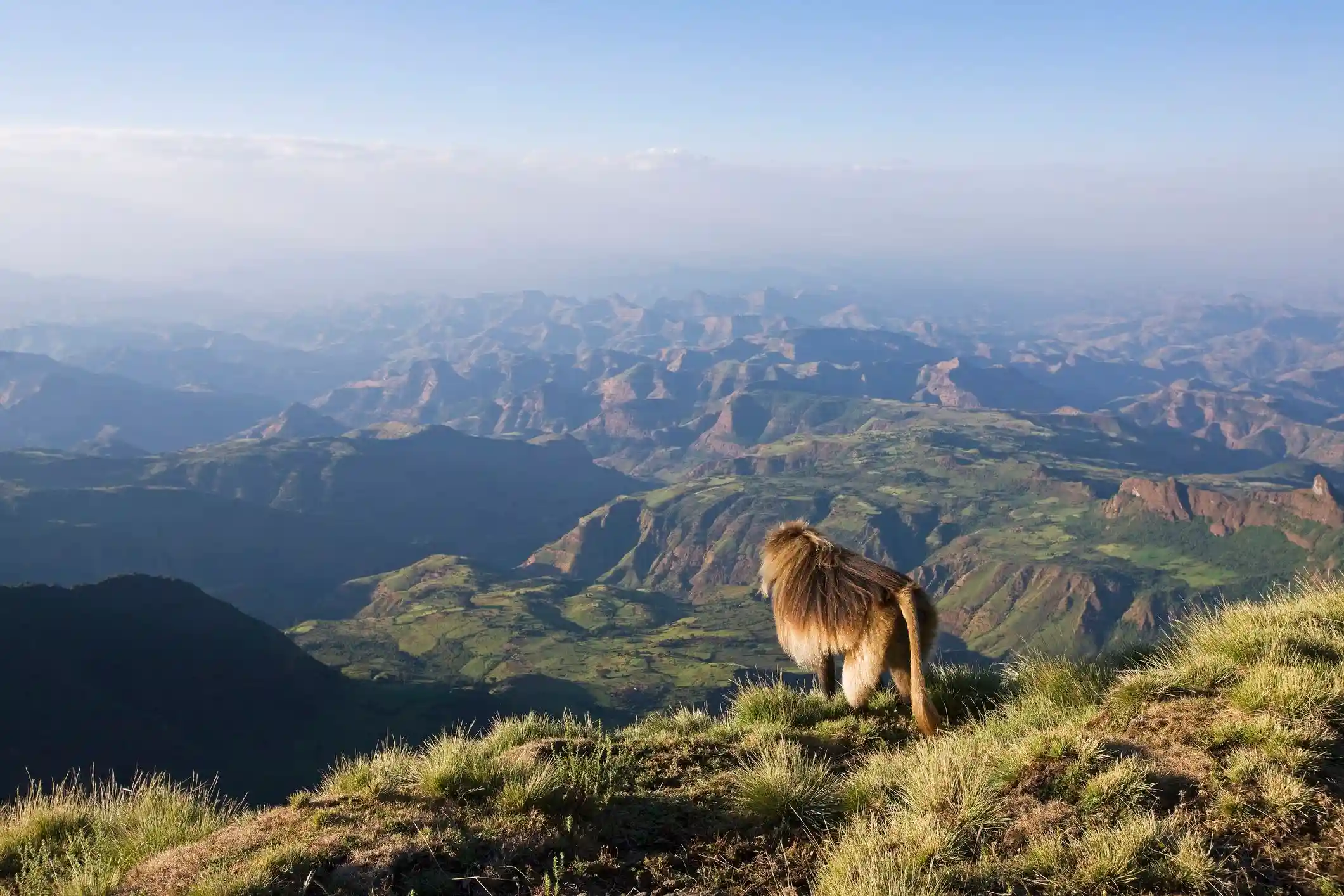
Drive to Dabark (the gate of Semein mountain park) arrangement of mules for loading materials and scout start trekking from Buyit Ras camp site and continue to Sankaber. This day trekking is a practice and a type acclimatization with the high altitude. En route you walk on the edge of the escarpment which has good view of the surrounding and there is chance to see the endemic Gelada baboon.
These baboons are grass eaters and will be seen in family units in many areas of the Semein. They are also known as the "the bleeding heart baboon" as there are red areas on the chest. Generally Debark - Buyit Ras - Sankaber is a trek that leads mainly through cultivated areas. Few indigenous trees will bee seen in the area except the introduced eucalyptus. In some areas, plants such as St. John's wort and heather will bee seen. Also many smaller herbs like Alchemila, Kiniphofia, red-hot pocker and Lobelia will be seen. In the afternoon reach Sankaber camp.
After early start you walk directly east ward, looking the escarpment northward, get in the valley of Koba rive. Viewing on the left the Geech Abyss reach the wonderful fall of Jin Bar (some times this fall is dry). Lunch from box and continue the trekking. Cross Jin Bar River, climb the steep land on the other side of the river, reach Geech camp (3600 mt. alt). En route you can view some endemic birds such as thick-billed raven, black-heade siskin, white-collared pigeon, wattled Ibis, and spot breasted plover. Geech is a camp site where you can see one of the biggest bird Lammergeyer.
After early start from Geech with pack lunch trek to different wonderful view points including Imitgogo with 3926 mt altitude gives the most spectacular views of the Semein both to north and east direction, the same to the View point of Saha. Back to Geech in the afternoon.
After early breakfast start trekking through forested valleys, cross Jin Bahir River, continue crossing the steep plain with the small hills, reach the escarpment of Enatiye which gives good view of the lowlands and the mountains of the surrounding. Take the chance and observe the endemic Walia Ibex grazing on the escarpments of the area. The walia Ibex is member of the wild goat family has magnificent heavily ridged horns sweeping back over it's shoulders.
The first 4 hours is very steep trekking to Mt. Buwahit (4430 mt. alt.), which lies to south-east of the camp site. From the edge of Buwahit there are many viewpoints of the surrounding including Mt Ras Dashen (the highest peak in Ethiopia, the 4th peak in Africa, 4543 mt.alt). Cross the valley of Meshesha River and reach Arkuwaziye for camping.
After breakfast, start trekking on the left side of Mt. Silki on the rolling small hills and plains. Some of these plains are cultivated. After 3 hours trekking reach a place called Sona (2970 mt. alt) which is a boundary between the highland and the lowland. From Sona, the next trekking is on dropping slop to the river valley of Ensay for about 2.30 hours. Reach the river, have shower in natural swimming pool, and lunch and continue to reach Mekarebia in late afternoon.
This day is a day to see very scenic mountains of Amba Toloka, Awaza (the mountains pictured on Ethiopian Airlines ticket) and others. Reach Mulit and camping on the side of small village. This gives good chance to see villagers life and their daily activity.
After early breakfast a 2 hours trekking reach a town of Adi Arkay, meet the car and drive back to Gondar. Check in to Hotel.
Fly to Addis Ababa, lunch, visit the national museum or ethnological museum of Addis Ababa University depending your arrival time in Addis.
National Museum : The museum is presenting selected artifacts worthy of exhibition using the best display techniques available as a means of education and enjoyment for the general public. Exhibits of the national museum are displayed under different sections. Paleontology and pre- history; - Lucy and other fossils including stone tools, Historical and Archaeological findings that depict the early history from the pre-Axumite times to the 16th century AD, Ethnography: - Traditional and ceremonial costumes, jewellery… etc. reflecting the diversified cultures of the various ethnic groups, Modern Art: - Selected paintings and sculptures from different Ethiopian artists, such as; Maitre Artist Laureate Afework Tekle. Almost every object has captions so that visitors can learn about the Nation’s rich history.
Ethnological Museum of Addis Ababa University : This contemporary museum truly displays superb artifacts and handicrafts from Ethiopia’s peoples. Instead of following the typical static and geographical layout that most museums fall into, these displays are based upon the life cycle. First comes Childhood, with birth, games, rites of passage and traditional tales. We particularly enjoyed the ‘Yem Tale’, a story of selfishness, dead leopards and sore tails! Adulthood probes into beliefs, nomadism, traditional medicine, war, pilgrimages, hunting, body culture and handicrafts. The last topic is Death and Beyond, with burial structures, stelae and tombs. The exhibition gives a great insight into Ethiopia’s many rich cultures.
Other rooms show the preserved bedroom, bathroom and exorbitant changing room of Emperor Haile Selassie,
The 2nd floor shows the vibrant hall focuses on religious art, with an exceptional series of diptychs, triptychs, icons, crosses and magic scrolls. The collection of icons is the largest and most representative in the world. Senses of another sort are traditional music gently fills the air and the black surrounds leave you nothing to look at besides the instruments – brilliant.
Afternoon shopping and then dinner in traditional restaurant with traditional song and dense, transfer to Airport for the flight to Tel Aviv.